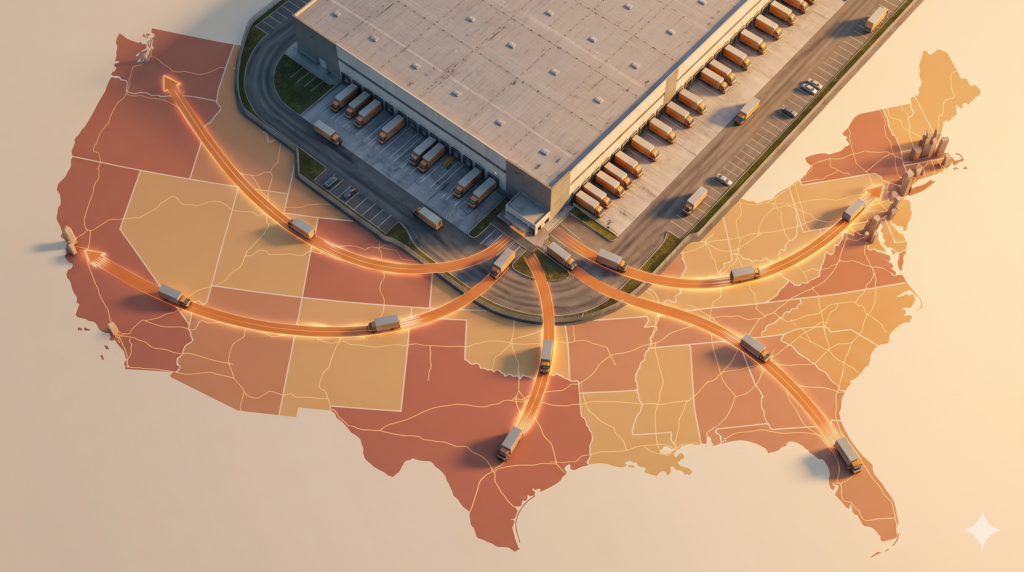
The biggest fulfillment mistake I see international brands make in cross-border ecommerce US is over-engineering their first warehouse footprint. They benchmark against Amazon, see fulfillment centers in 50 metros, and decide they need three or four locations from day one. That is how you tie up capital you should be spending on marketing tests and creative production.
The right answer is almost always one warehouse, central, with the cheapest reasonable carrier mix. You add nodes when the data tells you to, not when an Amazon dashboard tells you what “real” fulfillment looks like.
Contents
Phase 1: Validate from Europe before you ship a pallet
Before you ship inventory to a U.S. 3PL, ship orders to U.S. customers from your home country. Yes, transit times will be 7-14 days. Yes, conversion will be lower because of that. That is the point. You are buying real conversion data, real CAC data, and real customer feedback at the cost of slower delivery, before you commit working capital to U.S. stock.
The brands that skip this step almost always over-order on their first U.S. shipment. They forecast off optimism instead of data. Then they spend six months trying to move inventory that is not selling at the price point they assumed.
For international shipping during this phase, your existing carrier relationships from Europe usually work fine. DHL, UPS, FedEx all do international parcel reliably. The cost will be higher than U.S. domestic rates and that is okay; you are buying signal, not margin.
Phase 2: One central warehouse, not five
Once your tests show real demand, the next decision is where to land your first U.S. warehouse. My default recommendation: pick one central location, optimize for one to two day delivery to the largest population concentrations.
Three regions work well as single-node starting points:
- Dallas, Texas: Central time zone, Sun Belt access, no state income tax, robust 3PL ecosystem.
- Chicago, Illinois: Central time zone, strong rail and trucking access, dense Midwest population.
- Ohio / Indiana / Kentucky corridor: Slightly closer to the East Coast, popular with brands that want stronger Northeast service.
From any of these, a standard ground shipment will reach roughly 80 percent of the U.S. population within two to three days. That is fast enough for most categories. The U.S. consumer expects fast shipping, but they accept three-day delivery for non-impulse purchases. They do not accept seven-day, which is what your customer will see if you try to serve the country from Europe long-term.
How much inventory should you ship in your first run? My rule: 60 to 90 days of forecasted U.S. demand based on your test data. Not your European bestseller volume. Not your aspirational target. The number your 30-day test conversion rate justifies, multiplied by your forecast for the next quarter, with a small safety buffer.
The risk of over-shipping is bigger than the risk of stockouts on a new market launch. Stockouts are recoverable. Excess inventory in a foreign country, with potential expiration dates if you sell cosmetics or supplements, is hard to unwind. And if you decide to pause the U.S. launch for any reason, you now have to repatriate the stock or write it off.
Phase 3: Get the parcel carrier strategy right
This is where international brands get stuck because the U.S. carrier landscape is genuinely different from Europe. Here is the simple version of how it works in 2026.
The big three national carriers are FedEx, UPS, and the U.S. Postal Service. FedEx and UPS handle most parcels above one pound and provide the polished tracking experience European customers expect. USPS is the lowest-cost option for under-one-pound parcels and handles a huge volume of e-commerce last-mile.
DHL eCommerce is a hybrid: DHL moves the parcel through the U.S. network and hands off to USPS for final delivery. Common choice for sub-pound DTC orders.
Regional carriers are exploding in 2026. Companies like OnTrac, LSO (Lone Star Overnight), Pitt-Ohio, and a dozen smaller players cover specific regions and beat the national carriers on cost in their territories. Most established 3PLs work with 20-30 regional carriers and do dynamic rate-shopping to pick the cheapest reliable option per order.
Here is the practical advice: do not try to negotiate carrier contracts yourself when you are starting out. The volume isn’t there. Use your 3PL’s parcel rates. They have negotiated relationships built on aggregate volume across hundreds of brands, and even with their margin layered in, you will pay less than what you could secure direct.
One cultural note that catches international brands off-guard: U.S. consumers do not care which carrier delivers their package the way European consumers do. In the U.K., a parcel labeled with a particular carrier can change a customer’s expectation of the brand. In the U.S., as long as it shows up in two to three days, the carrier is invisible. That means you can optimize purely for cost and reliability without worrying about brand perception of the carrier.
Phase 4: When (and how) to add regional nodes
After 9 to 12 months of single-node operation, look at the data. The trigger to add a second warehouse is not “we hit a revenue milestone.” It is one of two specific conditions:
- Transit times are hurting conversion in a major region. If your conversion rate to West Coast customers is meaningfully lower than to customers within two-day range of your first warehouse, that is a signal to add a Western node (typically Los Angeles or Reno).
- Per-shipment cost from your single warehouse is climbing because too much volume goes long-distance. When the marginal cost of shipping coast-to-coast eats more margin than a second warehouse would cost, the math has flipped.
For a brand starting from Dallas, the most common second node is Los Angeles or Las Vegas/Reno for West Coast service. The third node, if you reach the volume to justify it, is typically the Northeast (New Jersey or Pennsylvania) for next-day service to NYC, Boston, and Philadelphia.
Europe-to-U.S. analogy: think of how brands run multi-node fulfillment in Europe (Netherlands plus Italy plus Romania, for example). The U.S. version is similar in concept but the distances are larger, so the value of a second node hits sooner once volume justifies it.
The 3 most expensive fulfillment mistakes I see
If you skip every other section of this post, internalize these three.
1. Over-investing in first-run inventory. The single most common mistake. Brands ship 6-12 months of forecasted stock based on hopeful projections, then watch it age in a warehouse. If you sell supplements or cosmetics with lot codes, you may end up with expiration risk on top of the carrying cost.
2. Going multi-node too early. Three warehouses sound impressive in a board meeting. They burn capital you should be spending on creative testing, retention infrastructure, and channel diversification. Stay single-node until volume forces the issue.
3. Trying to negotiate carrier rates as a small new entrant. Use the 3PL’s parcel rates. Renegotiate when you hit serious volume, typically 1,000+ daily shipments. Until then, your time is better spent on marketing.
FAQ
Where should an international brand put its first U.S. warehouse?
Dallas, Chicago, or the Ohio/Indiana corridor. All three give you 2-3 day ground service to roughly 80 percent of the U.S. population from a single node. Choose based on your specific customer geography and proximity to retail beachheads if applicable.
How much inventory should you ship for a first U.S. launch?
60 to 90 days of forecasted demand based on real test data, not European volume or aspirational targets. Stockouts are recoverable. Excess inventory abroad is expensive to unwind, especially for products with expiration dates.
Should you negotiate carrier contracts directly when starting out?
No. Use your 3PL’s negotiated parcel rates. They have aggregate volume relationships you cannot match as a new entrant. Renegotiate at 1,000+ daily shipments.
Do U.S. customers care which carrier delivers their package?
Less than European customers. In the U.S., as long as delivery is reliable and within 2-3 days, the carrier brand is largely invisible. You can optimize for cost over carrier reputation in most categories.
Key takeaways
- Validate U.S. demand from Europe first. Slower shipping is the price of buying real data before committing inventory.
- Start with one central warehouse. Dallas, Chicago, or Ohio/Indiana corridor each cover 80 percent of the U.S. population in 2-3 days.
- Ship 60-90 days of inventory based on test data, not optimistic forecasts. Over-investing is the #1 fulfillment mistake.
- Use your 3PL’s parcel rates. Skip direct carrier negotiation until you hit serious volume.
- Add regional nodes only when transit time is hurting conversion or coast-to-coast shipping cost outweighs the new warehouse cost.
Related Articles
- Why the U.S. Market Is Really 50 Countries
- The 5 Signals That Tell You a European Brand Is Actually Ready for the U.S.
- The Non-Negotiable U.S. Market Entry Checklist for European Brands